
Cascade Impactor (APSD) testing
Cascade Impactor testing – The Gold Standard for Inhalation Performance
Aerodynamic Particle Size Distribution (APSD) is the most pivotal quality attribute for any inhaled or nebulized drug product. It decides where a drug will deposit within the respiratory tract—and ultimately, how effective the treatment will be.
At Emmace, we provide comprehensive Cascade Impactor (CI) testing services, using industry-leading instrumentation and deep scientific ability to characterize the performance of MDIs, DPIs, nebulizers, and nasal sprays.
Why APSD Testing Matters
For an inhaled medication to reach the deep lungs (the bronchioles and alveoli), the particles/droplets must generally fall within the 1 to 5-micrometer range. Larger particles tend to not pass the throat (oropharyngeal deposition), while particles that are too small may be exhaled without depositing.
Our testing services help you:
- Quantify the Fine Particle Mass (FPM): The dose fraction is likely to reach the lung region.
- Calculation of MMAD and GSD: Calculating the Mass Median Aerodynamic Diameter and Geometric Standard Deviation to understand the aerosol’s consistency.
- Ensure Regulatory Compliance: Providing the data required for CMC (Chemistry, Manufacturing, and Controls) sections of IND, NDA, and ANDA submissions.
All APSD testing at Emmace can be performed following USP or EU pharmacopeias.
See also related subject Delivered dose/emitted dose testing.
Partner with Emmace
Whether you are in early-stage formulation development or final product characterization, our team provides the precision and insight needed to bring your inhalation product to market.
Our Technical Capabilities
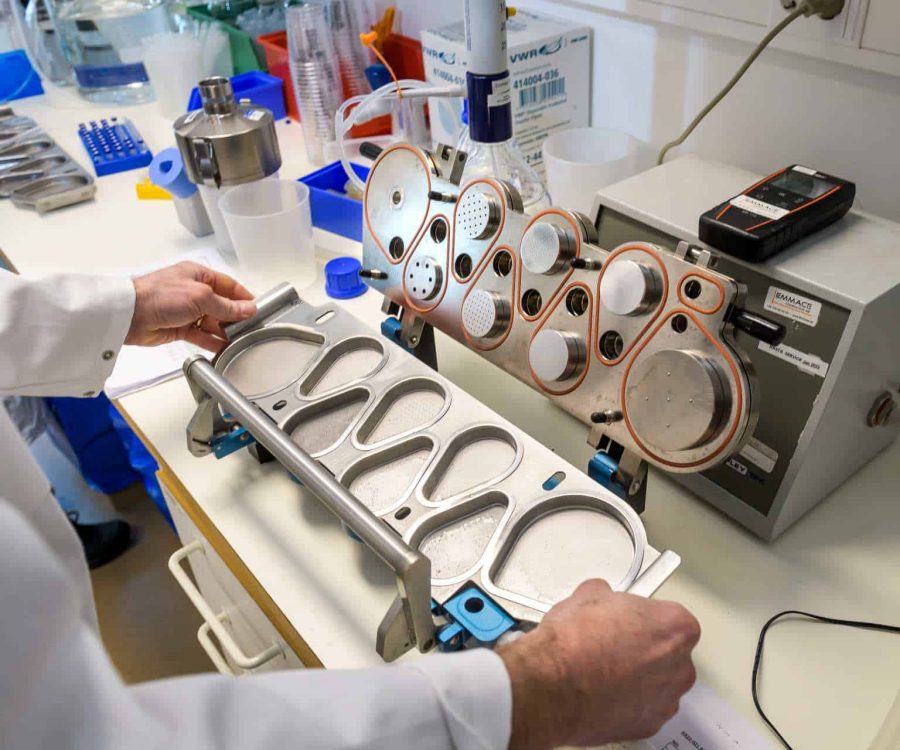
We use both the Next Generation Impactor (NGI) and the Andersen Cascade Impactor (ACI) to provide high-resolution mapping of your device’s aerosol performance.
Specialized Testing Conditions:
Standard testing often does not capture the reality of patient use. Emmace goes beyond the basics to offer specialized configurations:
- Controlled Environment Testing: We can perform APSD testing at specific temperatures and humidity levels to simulate real-world storage and use conditions.
- Cooled Impactor Testing: For aerosol droplets sensitive to evaporation (Nebulizers and soft mist inhalers), we offer cooled NGI setups to minimize bias for correct MMAD and GSD determination.
- Low and High Flow Rate Capabilities: Testing across a range of flow rates to evaluate the “flow rate dependency” of your device, a critical factor for patient-to-patient variability.
- Seamless links to
- rAPSD: The use of anatomical throats in combination with realistic patient inhalation profiles, so called realistic APSD, is one of Emmace’s specialty. This methodology is used in comparative studies for generic “Bioequivalence” (IVIVC) to prove similarity between Reference Listed Drugs (RLD) and test products.
- Lung Regional Deposition Modeling (RDM): performed by Emmace on the rAPSD data using the well-known software Mimetikos Preludium.